


Buying your first CPAP machine can feel like a lot, especially right after a sleep apnea diagnosis when you are still exhausted and already juggling insurance, prescriptions, and dozens of look-alike models. If you made it to this guide, you are taking your sleep seriously, so let us make the process simple.
Here is the short version. Buying a CPAP machine in the United States comes down to four steps:
- Get diagnosed with a sleep study, either in a lab or at home.
- Get a prescription from a licensed provider.
- Choose the machine type, features, and mask that fit you.
- Buy from an authorized seller who verifies your prescription.
Below we walk through each step, what a machine actually costs, where to buy one, and the models we see work best for first-time users. Modern CPAP machines are quieter and smarter than the units of a decade ago, so the goal is matching the right one to you, not chasing the most expensive.
What is a CPAP machine?
A CPAP (continuous positive airway pressure) machine is a small bedside device that treats obstructive sleep apnea. It delivers a steady stream of pressurized air through a hose and mask, which keeps your airway open so your breathing does not pause during sleep. According to Cleveland Clinic, the device "delivers continuous air through your mouth and/or nose to help keep your airways open while you sleep."
Standard CPAP is one of three related machine types, alongside auto-adjusting CPAP and bilevel (BiPAP). If you want the mechanics first, our guide on how a CPAP machine works breaks it down, and you can browse every model on our CPAP machines page.
Do you need a prescription to buy a CPAP machine?
Yes. In the United States you need a prescription to buy a CPAP machine. The FDA regulates CPAP as a Class II medical device, which means it is prescription-only and set to a pressure your provider specifies. So no, you cannot just buy a CPAP machine off the shelf the way you would a humidifier.
You may see sellers advertising CPAP machines with "no prescription needed." We would skip them. A machine set to the wrong pressure can make therapy ineffective or uncomfortable, and any legitimate, authorized seller will always ask for your prescription first. It protects you, not just the store.
If you do not have a prescription yet, you often do not need to start with an in-person visit. Many people get evaluated through telehealth: an online screening, an at-home sleep test, and a prescription, all without a clinic appointment. We cover the details in our guide to getting a CPAP machine without a prescription, and our home sleep study can start that path from home.
How do you get diagnosed with sleep apnea?
Sleep apnea is diagnosed with a sleep study, either an overnight test in a sleep lab (polysomnography) or a home sleep apnea test you take in your own bed. As the American Academy of Sleep Medicine puts it, "your medical provider can diagnose sleep apnea using a sleep study in a sleep lab or at home." Mayo Clinic notes you may have an at-home version of that test under the right circumstances.
Home testing is not a shortcut of last resort. The AASM's clinical guideline recommends a home sleep apnea test with an adequate device for diagnosing uncomplicated moderate to severe sleep apnea in adults (Kapur et al., 2017). If you suspect sleep apnea, start with your provider, and consider a home sleep test to speed things up before your appointment. Our full walkthrough on sleep apnea diagnosis covers what to expect.
 WatchPAT Home Sleep Test
An FDA-cleared home sleep apnea test you take in your own bed, no overnight lab required.
$139.00
WatchPAT Home Sleep Test
An FDA-cleared home sleep apnea test you take in your own bed, no overnight lab required.
$139.00
How to choose the right CPAP machine
Once you have a prescription, choosing a machine comes down to four things: the machine type, the features you actually need, the mask, and your budget. Here is how to weigh each one.
CPAP vs APAP vs BiPAP (and travel machines)
In short: a standard CPAP delivers one constant pressure all night, an auto-adjusting CPAP raises and lowers the pressure automatically as your breathing changes, and a BiPAP uses two separate pressures, a higher one when you breathe in and a lower one when you breathe out.
An APAP machine, also called an auto-adjusting or auto CPAP, monitors your breathing and changes the pressure moment to moment instead of holding one fixed setting. As Cleveland Clinic explains, "a CPAP machine provides a fixed level of pressure as you sleep. An APAP machine adjusts its pressure levels according to your breathing patterns." Most machines sold today are auto-adjusting, which is why they suit so many first-time users.
Machine type |
What it does |
Best for |
Prescription |
Price (example model) |
Example model |
CPAP (fixed) |
One constant pressure all night |
Stable, single-pressure prescriptions |
Fixed-pressure Rx |
$754 |
|
APAP (auto) |
Adjusts pressure automatically as you breathe |
Most users, changing needs, first-timers |
Auto-titrating Rx |
$1,004 |
|
BiPAP (bilevel) |
Two pressures, higher in and lower out |
Higher pressures or exhale trouble |
Bilevel Rx |
$1,199 |
|
Travel CPAP |
Compact, often FAA-accepted for flights |
Frequent travelers and backup use |
Same as your main Rx |
$919 |
Want to go deeper on a type? Compare APAP vs CPAP and CPAP vs BiPAP, or browse our auto-adjusting CPAP machines, best BiPAP machines, and travel CPAP machines.
Key features to look for
Modern CPAP machines bundle most of these into one quiet unit, so focus on the ones that solve a real problem for you:
- Ramp and AutoRamp: start at a lower, easier pressure that builds up as you fall asleep. Our guide to the ramp function explains when to use it.
- Humidification: a heated humidifier adds moisture to the air and prevents the dry mouth, nose, and throat that make many people quit early.
- Exhalation relief: drops the pressure slightly as you breathe out so exhaling feels more natural.
- Leak detection: alerts you, or auto-adjusts, when your mask seal breaks so you keep getting your prescribed pressure.
- FAA-accepted for flight: matters only if you plan to use the machine in the air. Most travel models qualify.
Choosing a mask
The mask makes or breaks CPAP therapy, often more than the machine. There are three main styles: nasal pillow masks (lightweight, good for facial hair and claustrophobia), nasal masks (the most popular all-rounder), and full face masks (best if you breathe through your mouth). Because fit is personal, we back mask purchases with a 60-night fit guarantee, so you can find the one that works.
Not sure where to start? See our picks for nasal pillow masks, nasal masks, and full face masks.
Brands we carry
We are an Authorized ResMed Dealer, and we also carry Fisher & Paykel, React Health (3B Medical), Philips Respironics, and Apex Medical. Each brand has strengths: ResMed and Philips lead on connected features and app tracking, Fisher & Paykel is known for comfortable humidification, and React Health and Apex offer dependable machines at a lower price. You do not need the priciest brand, you need the one that matches your prescription and comfort needs.
Cost, insurance, and payment
Most CPAP and APAP machines cost roughly $700 to $1,200 without insurance, and bilevel (BiPAP) machines run higher. CPAP machines are generally an eligible FSA and HSA expense, and many are covered in part by insurance or Medicare after a qualifying sleep study. If budget is the deciding factor, we offer financing, and our price match guarantee means if you find a lower price elsewhere, we can match it.
For a full breakdown, see how much a CPAP machine costs and our guide to CPAP financing.
Where should you buy a CPAP machine?
Yes, you can buy a CPAP machine online, and for most people it is the easiest option. You generally have three paths: an authorized online CPAP retailer, a local durable medical equipment (DME) supplier, or a sleep clinic. Online usually wins on selection and price, while a local supplier lets you handle a mask in person.
Wherever you buy, choose an authorized seller. That means one that verifies your prescription, sells genuine equipment (not gray-market imports), honors the manufacturer warranty, and gives you real support after the sale. We do not recommend buying a used CPAP machine from online marketplaces or private sellers: you cannot verify the run hours, hygiene, or pressure history, and those sales usually skip the prescription check that keeps therapy safe. When you are ready, you can compare every model on our CPAP machines page.
Popular CPAP machines to consider
We sell the machines below as an authorized dealer, and we chose them from what we actually ship and support most, not a paid ranking. Match one to how you sleep and travel.
Best all-around flagship: the ResMed AirSense 11 auto-adjusts all night, has a heated humidifier and a touchscreen, and syncs to the myAir app, which makes it an easy first machine.
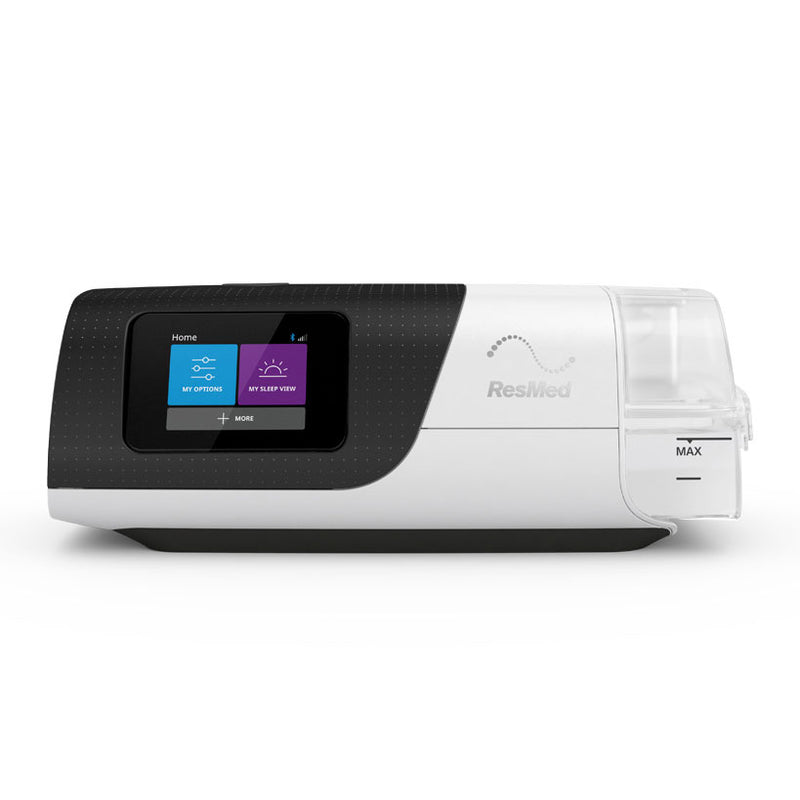 ResMed AirSense 11 AutoSet CPAP Machine
ResMed's flagship auto-adjusting CPAP with heated humidification, touchscreen, and app-based therapy tracking.
$1,004.00
ResMed AirSense 11 AutoSet CPAP Machine
ResMed's flagship auto-adjusting CPAP with heated humidification, touchscreen, and app-based therapy tracking.
$1,004.00
Best value: the React Health Luna G3 delivers auto-adjusting therapy, a built-in heated humidifier, and quiet operation at a lower price point.
 React Health Luna G3 Auto CPAP Machine with Heated Humidifier
A quiet, auto-adjusting CPAP with an integrated heated humidifier at a budget-friendly price.
$754.00
React Health Luna G3 Auto CPAP Machine with Heated Humidifier
A quiet, auto-adjusting CPAP with an integrated heated humidifier at a budget-friendly price.
$754.00
Best for travel: the ResMed AirMini is one of the smallest auto-adjusting machines, and the Transcend Micro is another compact, FAA-accepted option for the road.
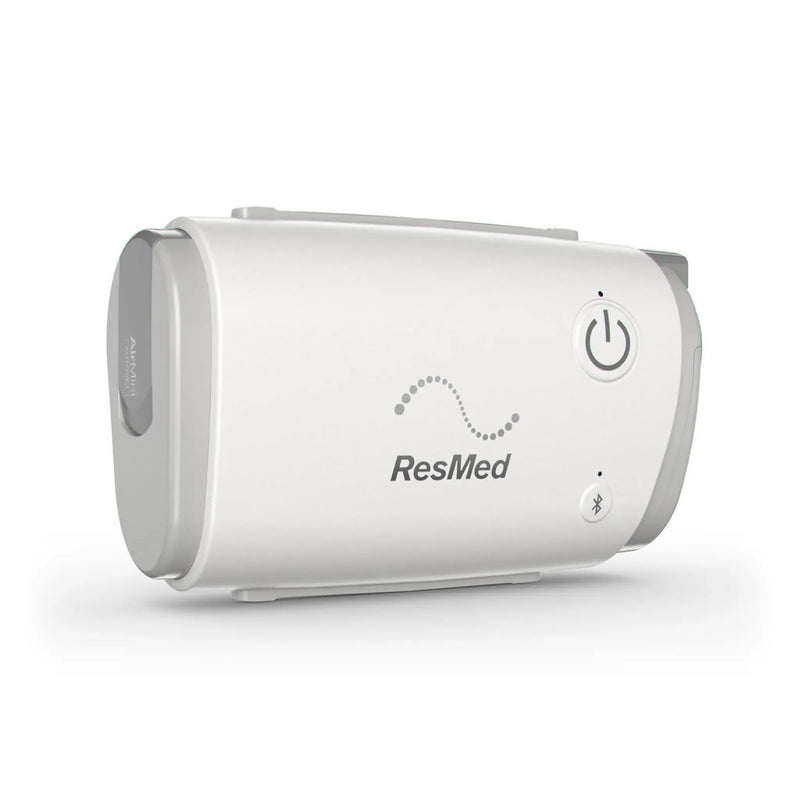 ResMed AirMini AutoSet Travel CPAP Machine
One of the smallest auto-adjusting travel CPAP machines, FAA-accepted for in-flight use.
$919.00
ResMed AirMini AutoSet Travel CPAP Machine
One of the smallest auto-adjusting travel CPAP machines, FAA-accepted for in-flight use.
$919.00
 Transcend Micro Auto Travel CPAP Machine
A pocket-sized, FAA-accepted auto travel CPAP for frequent flyers and backup use.
$779.00
Transcend Micro Auto Travel CPAP Machine
A pocket-sized, FAA-accepted auto travel CPAP for frequent flyers and backup use.
$779.00
Best for bilevel therapy: if your prescription calls for two pressures, the ResMed AirCurve 10 VAuto is a widely used bilevel machine.
 ResMed AirCurve 10 VAuto BiPAP Machine with HumidAir Heated Humidifier
A bilevel (BiPAP) machine with two pressure settings for easier exhalation and higher-pressure needs.
$1,199.00
ResMed AirCurve 10 VAuto BiPAP Machine with HumidAir Heated Humidifier
A bilevel (BiPAP) machine with two pressure settings for easier exhalation and higher-pressure needs.
$1,199.00
Want the full comparison? See our best CPAP machines review, or browse the complete lineup of CPAP machines.
Frequently Asked Questions
Can I just buy a CPAP machine?
No. In the United States a CPAP machine is a prescription medical device, so you need a prescription from a licensed provider first. Once you have one, you can buy online or from a local supplier.
Can you buy a CPAP machine online?
Yes. You can buy a CPAP machine online from an authorized seller once you have a valid prescription, which the seller verifies before shipping your machine.
Do you need a prescription to buy a CPAP machine?
Yes. The FDA regulates CPAP as a Class II medical device, so a prescription is required. A sleep study determines both your diagnosis and the pressure setting on your prescription.
How much does a CPAP machine cost?
Most CPAP and APAP machines cost about $700 to $1,200 without insurance, and bilevel (BiPAP) machines cost more. CPAP machines are generally FSA and HSA eligible, and insurance or Medicare may cover part of the cost.
What is the difference between CPAP and APAP?
A standard CPAP delivers one fixed pressure all night. An APAP, or auto-adjusting CPAP, raises and lowers the pressure automatically as your breathing changes. Most machines sold today are auto-adjusting.
Can I use FSA or HSA funds to buy a CPAP machine?
Yes. CPAP machines and most supplies are typically eligible FSA and HSA expenses. Keep your prescription and receipt for your records in case your plan asks for them.
Do I need an in-person doctor visit to get a prescription?
Not always. Many people get diagnosed and prescribed through telehealth: an online screening, an at-home sleep test, and then a prescription, without visiting a clinic in person.
What is a modern CPAP machine?
Modern CPAP machines are quieter, smaller, and auto-adjusting, with built-in heated humidifiers and app-based therapy tracking, unlike the older fixed-pressure units of a decade ago.
References
- American Academy of Sleep Medicine. "Obstructive Sleep Apnea." Sleep Education. sleepeducation.org
- Kapur VK, et al. "Clinical Practice Guideline for Diagnostic Testing for Adult Obstructive Sleep Apnea." Journal of Clinical Sleep Medicine, 2017. PubMed (PMID 28162150)
- Mayo Clinic. "Obstructive Sleep Apnea: Diagnosis & Treatment," 2024. mayoclinic.org
- Cleveland Clinic. "CPAP Machine." my.clevelandclinic.org
- Cleveland Clinic. "APAP Machine." my.clevelandclinic.org
- U.S. Food & Drug Administration. "Product Classification: Continuous Positive Airway Pressure (CPAP), Class II." accessdata.fda.gov
Get useful articles straight to your inbox


